Description
Falcon instruments are the established industry standard for x2 bi-directional UFS and UniPro compliance testing, debug and protocol analysis. The Falcon 600R/G650R (RAD, real-time analog display) series of instruments are transformational products, combining the capabilities of an oscilloscope and a protocol exerciser analyzer into a single product. This dramatically improves the test capabilities available to developers and test engineers, allowing them to quickly identify complex protocol and signal issues with a single piece of test equipment.
The Falcon G600R is a UFS and UniPro protocol analyzer with real-time analog display capabilities. The G600R protocol analyzer is a “sniffer” that can capture up to 4-lanes of traffic, a x2 bi-directional link. It supports up to UFS 5.0, UniPro 3.0, and MIPI M-PHY 6.0 HS-G6.
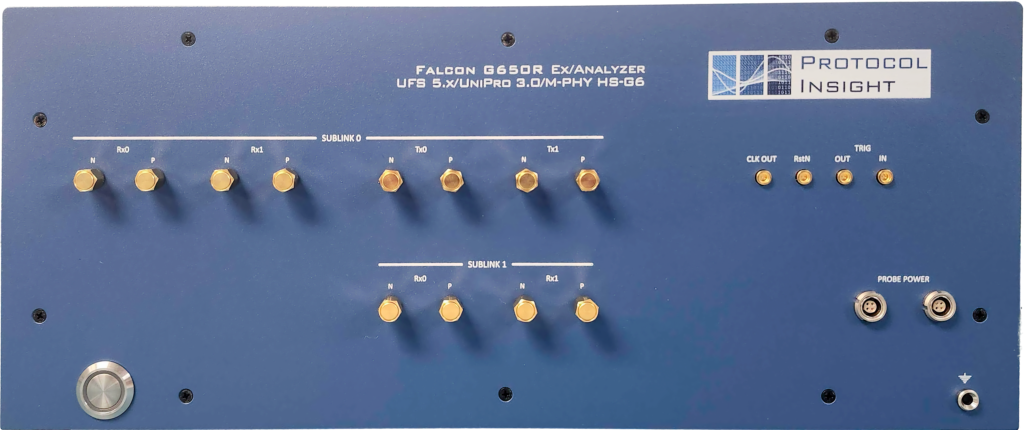
The Falcon G650R is a protocol exerciser analyzer. The G650R has all of the capabilities of the G600R protocol analyzer and adds protocol exerciser functionality. The G650R can generate link traffic on a x2 bi-directional link while simultaneously capturing the response traffic from the DUT. The Falcon G650R exerciser can execute the forthcoming UniPro 3.0 CTS and JEDEC JESD224A (UFS 5.0, UFS 4.0, UFS 3.1) UFS Compliance/Conformance Test Suites (CTS). The Falcon G650R is also capable of executing the CTS test from the prior Falcon C generation, supporting Unipro 2.0, UniPro 1.8 and UFS 4.1, UFS 4.0 and UFS 3.1.
The Falcon R series is available with the following features:
- Smart Tune™ Calibration – Capturing the signal from the DUT can be problematic when trace routing or the cabling to the test fixture causes poor signal integrity or probing issues. SmartTune™ Calibration automatically optimizes signal acquisition by calibrating the instrument to the system under test. This helps to ensure error-free M-PHY symbol capture with the analyzer.
- Eye Monitor, Eye Slicer and SNR View – You can construct an eye diagram of a link to determine the link quality by exporting the real-time analog data (RAD). The data can be viewed in an offline viewer, which can construct an eye diagram when provided with constructs an eye diagram of the link to determine link quality. Qualitative measurements can be done on the eye diagram for jitter, noise, and eye opening. The Slicer Eye viewer provides a dynamic rolling view of eye quality and is part of the real-time analog display windowpane.
- Trace Validation™ – is a patented Artificial intelligence (AI) tool that uses complex state machine logic to analyze traces algorithmically without user inference. It analyzes bi-directional UniPro and UFS traffic, performing protocol sequence and timing analysis and packet header and payload inspection.
- Events Views – displays raw UniPro symbols as packet events on the bus in a unique time-aligned display. UniPro Events view displays fillers, Prepare, SYNC, Hibern8, sleep, stall and other M-PHY level packets. UFS Events displays each individual UFS packet type separately. UniPro and UFS Events views presents a complete picture of all events and allows drill-down to the lowest level bytes.
- Compliance/Conformance Verification – executes JEDEC and MIPI CTS test cases.
- Compliance Verificaiton – verifies compliance of UFS devices with the UFSA UFS Compliance Test Matrix.
- Stimulus with full UniPro stack in HW – allows host emulation and the creation of specific traffic on the link, and offers extensive error injection.
- Run Time Control stress testing – controls the DUT and executes tests automatically. Stop after any number of loops or No Result Test Cases, then analyze the results with Trace Validation.
- Custom Test Cases – users can design custom test cases to introduce errors for corner case, margin, or stress testing.
- Streaming capture – uses the full 40Gbs bandwidth of Thunderbolt 3/4 to store link traffic directly to disk in real time.